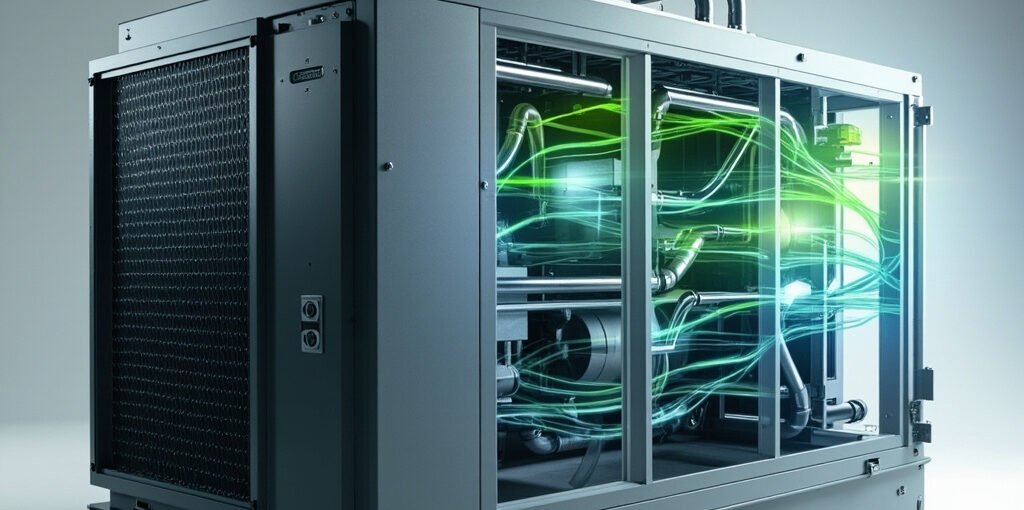
Variable frequency compressor energy saving represents one of the most significant advancements in industrial compressed air systems over the past two decades. As manufacturing facilities worldwide strive to reduce operational costs and minimize their environmental footprint, variable frequency drive (VFD) technology has emerged as a game-changing solution that can deliver energy savings ranging from 25% to 50% compared to traditional fixed-speed compression systems. This comprehensive guide explores how variable frequency compressors work, their energy-saving mechanisms, practical implementation strategies, and the substantial financial benefits they offer to businesses across diverse industries.
Understanding Variable Frequency Compressor Technology
A variable frequency compressor, also known as a variable speed drive (VSD) compressor, incorporates electronic controls that adjust the motor speed based on real-time air demand. Unlike conventional compressors that operate at a constant speed and use load/unload cycles or throttle valves to manage output, VFD compressors continuously modulate their motor speed to match precisely the air requirements of the facility. This fundamental difference in operation creates substantial energy savings because compressed air production is directly proportional to the cube of motor speed—a small reduction in speed yields dramatic decreases in power consumption.
The technology behind variable frequency compressor energy saving involves sophisticated power electronics that convert incoming alternating current (AC) to direct current (DC) and then back to AC at variable frequencies. This frequency variation controls the motor’s revolutions per minute (RPM), allowing the compressor to respond dynamically to fluctuating demand. Modern VFD compressors can adjust their speed within a range typically spanning 30% to 100% of rated capacity, providing unprecedented flexibility in matching supply with demand.
The Physics Behind Variable Frequency Compressor Energy Saving
To fully appreciate why variable frequency compressor energy saving is so substantial, it’s essential to understand the fundamental relationship between motor speed and power consumption. The affinity laws governing centrifugal equipment establish that:
- Flow is directly proportional to speed: Reducing motor speed by 20% decreases flow by 20%
- Power is proportional to the cube of speed: Reducing motor speed by 20% decreases power consumption by approximately 49%
- Pressure relates to the square of speed: Speed reductions affect head pressure quadratically
These affinity laws demonstrate why variable frequency compressor energy saving exceeds what intuition might suggest. When a facility’s air demand drops during off-peak hours, a VFD compressor can significantly reduce its energy consumption by slowing the motor, whereas a fixed-speed compressor would continue running at full speed, consuming nearly identical power while venting excess air or operating inefficiently through load/unload cycling.
💡 Key Insight: A 10% reduction in motor speed can yield approximately 27% energy savings, while a 20% speed reduction can achieve nearly 50% power savings. This exponential relationship is the foundation of variable frequency compressor energy efficiency.
Variable Frequency Compressor vs. Fixed Speed Compressor: A Comparison
Understanding the operational differences between variable frequency and fixed-speed compressors is crucial for facilities considering upgrades or new installations. The following comparison illustrates the advantages that drive variable frequency compressor energy saving adoption across industries.
| Parameter | Fixed Speed Compressor | Variable Frequency Compressor |
|---|---|---|
| Energy Efficiency | Lower, with significant part-load losses | High efficiency across load ranges |
| Load Matching | Poor, uses on/off or throttle control | Excellent, continuous modulation |
| Start Current | High inrush current (6-8x rated) | Soft start, minimal inrush |
| Lifespan | Mechanical wear from cycling | Reduced wear, longer component life |
| Noise Levels | Constant high noise during operation | Variable noise, lower at reduced load |
| Maintenance Costs | Higher due to frequent cycling | Lower maintenance requirements |
Key Energy Saving Features of Variable Frequency Compressors
Precise Pressure Control
Variable frequency compressor energy saving begins with remarkably precise pressure control. Traditional fixed-speed systems must maintain pressure within a wide band to prevent frequent cycling, often operating at pressures 10-15 psi higher than necessary. VFD compressors can maintain tight pressure bands (±1 psi), allowing the system to operate at the minimum required pressure. Since power consumption increases proportionally with pressure, this seemingly minor adjustment contributes significantly to overall energy savings.
Elimination of Unloaded Running Losses
Fixed-speed compressors typically consume 20-30% of full-load power even when unloaded. They employ various methods to handle excess capacity—blow-off valves, throttled suction, or simple on/off cycling—all resulting in wasted energy. Variable frequency compressors eliminate this inefficiency by simply slowing down to match the reduced demand, avoiding unloaded operation almost entirely.
Soft Starting and Reduced Electrical Stress
The VFD’s soft-start capability contributes to variable frequency compressor energy saving in multiple ways. By ramping up the motor gradually instead of applying full voltage, VFDs eliminate the high starting currents that stress electrical systems and increase utility demand charges. This soft-start function also reduces mechanical stress on bearings, seals, and drive components, extending equipment life and reducing replacement costs.
Power Factor Correction
Modern VFD compressors incorporate power factor correction systems that maintain power factors above 0.95 across the operating range. This improvement reduces reactive power consumption, minimizes line losses, and may qualify facilities for utility incentives or lower demand charges. Fixed-speed compressors often exhibit poor power factors, particularly at part-load conditions, resulting in additional energy costs.
Industries and Applications Benefiting from VFD Compressors
Variable frequency compressor energy saving technology benefits facilities across numerous industries where air demand varies throughout production cycles or between shifts. Understanding which applications yield the greatest returns helps businesses prioritize investment decisions.
- Manufacturing Operations: Facilities with varying production rates, shift schedules, or seasonal demand patterns often achieve 35-45% energy reductions with VFD systems.
- Food and Beverage Processing: Stringent hygiene requirements and batch processing create variable air demands that VFD compressors handle efficiently.
- Pharmaceutical Manufacturing: Clean, consistent air supply with precise pressure control supports both quality and energy efficiency.
- Automotive Assembly: Multiple workstations with intermittent tool usage create fluctuating demand patterns ideal for VFD optimization.
- Packaging Operations: Variable production speeds and batch processing benefit from responsive VFD capacity modulation.
- HVAC and Building Systems: Compressed air for controls and instrumentation adapts naturally to VFD technology.
Real-World Energy Savings and ROI Analysis
Concrete data on variable frequency compressor energy saving helps decision-makers justify capital investments and plan implementations. The following table presents typical savings scenarios based on facility characteristics and operational patterns.
| Facility Profile | Typical Demand Variation | Expected Energy Savings | Average Payback Period |
|---|---|---|---|
| Single-shift manufacturing | 40-60% variation | 25-35% | 2.5-3.5 years |
| Multi-shift operations | 30-50% variation | 20-30% | 3-4 years |
| Continuous process industries | 15-25% variation |