In modern manufacturing and industrial automation, the robot tool change application has emerged as a transformative technology that dramatically increases flexibility, productivity, and return on investment. By enabling a single robot to perform multiple tasks through automatic tool switching, manufacturers can reduce downtime, minimize floor space, and reconfigure production lines in minutes rather than hours. This comprehensive guide explores everything you need to know about robot tool changing systems, their components, working principles, benefits, and the industries that rely on them.
What Is a Robot Tool Change Application?
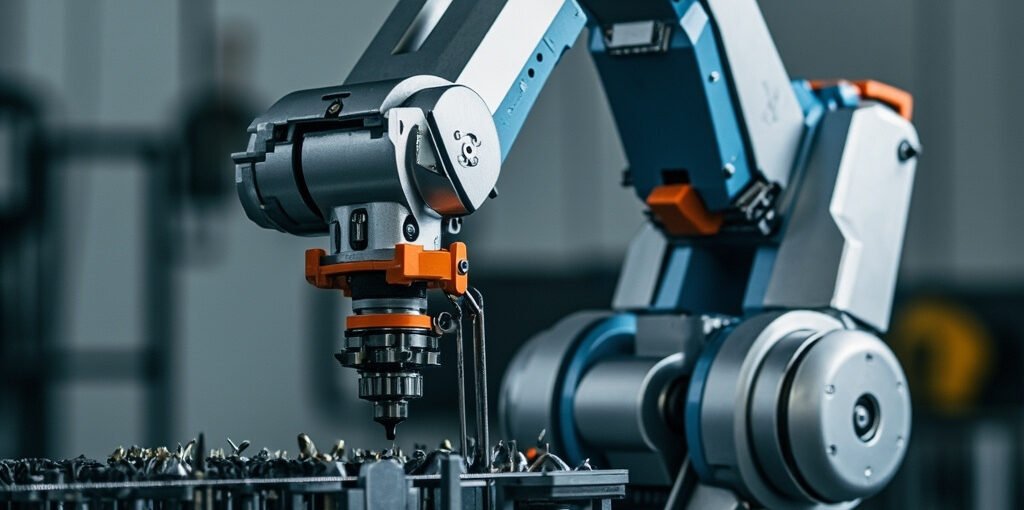
A robot tool change application refers to the automated process by which an industrial robot exchanges its end-of-arm tooling (EOAT) without human intervention. The system typically includes a tool changer, a tool storage rack or magazine, and the software that controls the sequencing. When properly integrated, the robot can switch from a welding torch to a gripper, a paint sprayer to a drilling head, or a vacuum cup to a stud-welding gun in a matter of seconds. This eliminates the need for multiple dedicated robots and enables true multi-functional robotic cells.
How Does an Automatic Tool Changer Work?
The working principle of an automatic tool changer (ATC) involves three main phases: parking, coupling, and verification. First, the robot moves to the tool storage station and aligns its master plate with the tool’s corresponding plate. A locking mechanism, often pneumatic or cam-driven, then secures the connection while simultaneously engaging electrical, pneumatic, hydraulic, and data contacts. Finally, sensors confirm proper engagement before the robot resumes its task. Modern systems can complete an entire tool change cycle in under 3 seconds, making them ideal for high-mix, low-volume production environments.
Key Components of a Robot Tool Change System
- Master Plate: Mounted on the robot arm, this side contains the locking mechanism and all utility connections.
- Tool Plate: Attached to each individual tool, this side mates with the master plate during engagement.
- Locking Mechanism: Cam-action, ball-locking, or piston-driven systems that secure the connection with high clamping force.
- Coupling Modules: Quick-connect modules for air, water, electrical signals, and high-current power transmission.
- Tool Storage Rack: A structured station that holds multiple tools in pre-defined positions for repeatable access.
- Control Software: PLC or robot controller logic that orchestrates the change sequence and verifies successful docking.
Comparison of Tool Change Technologies
| Technology Type | Cycle Time | Payload Capacity | Best Use Case |
|---|---|---|---|
| Manual Tool Change | 5–15 minutes | Unlimited | Low-volume, heavy payloads |
| Pneumatic ATC | 1.5–3 seconds | Up to 1,500 kg | High-speed assembly lines |
| Cam-Locking ATC | 2–4 seconds | Up to 2,000 kg | Heavy-duty welding & machining |
| Servo-Driven ATC | 3–6 seconds | Up to 3,000 kg | Precision applications |
Industries That Benefit from Robot Tool Changing
- Automotive Manufacturing: Used for spot welding, stud welding, sealing, and part handling on the same production line.
- Aerospace Engineering: Enables drilling, riveting, inspection, and surface finishing on large structural components.
- Metal Fabrication: Supports plasma cutting, grinding, deburring, and material handling with one robotic cell.
- Electronics Assembly: Allows precision screwdriving, dispensing, pick-and-place, and testing operations.
- Food and Packaging: Facilitates quick sanitation-friendly tool swaps for varied product sizes.
- Plastics and Molding: Performs insert loading, deflashing, inspection, and trimming without operator intervention.
Top Benefits of Implementing Robot Tool Change Applications
- Increased Uptime: Reduces non-productive changeover time by up to 90 percent compared with manual systems.
- Cost Efficiency: One robot can replace three or more dedicated machines, significantly lowering capital expenditure.
- Production Flexibility: Enables rapid reconfiguration for new SKUs, supporting mass customization trends.
- Improved Safety: Eliminates risky manual handling of heavy or sharp tools, reducing workplace injuries.
- Higher Repeatability: Automated docking ensures consistent tool positioning, improving first-pass quality.
- Smaller Footprint: A single robotic cell occupies less floor space than several standalone units.
Best Practices for Successful Implementation
Successful deployment of a robotic tool changing system requires careful planning. Begin by mapping all process steps and identifying tools that share similar mechanical and electrical requirements. Use a centralized tool storage tower or linear magazine to minimize robot travel distance. Always integrate vision verification or RFID tagging to prevent the wrong tool from being picked. Additionally, schedule preventive maintenance every 1,000–2,000 cycles to inspect contact wear, locking mechanisms, and sealing integrity. Training operators on fault recovery protocols is equally important to minimize unplanned downtime.
Common Challenges and Solutions
| Challenge | Recommended Solution |
|---|---|
| Inconsistent docking alignment | Use tapered guide pins and vision systems |
| Contamination of electrical contacts | Specify IP67-rated sealed connectors |
| Long changeover programming time | Leverage pre-built macro libraries in robot software |
| Tool damage from improper seating | Add force/torque feedback sensors |
Future Trends in Robot Tool Change Technology
The future of robot tool change applications is being shaped by Industry 4.0, artificial intelligence, and collaborative robotics. Emerging systems incorporate IoT-enabled sensors that monitor tool wear, usage hours, and predictive maintenance requirements in real time. AI-driven scheduling algorithms now optimize tool sequencing to minimize total cycle time. Furthermore, the rise of cobots is driving the development of lightweight, low-payload tool changers that maintain safety compliance while delivering the same flexibility as traditional industrial systems. As 5G connectivity and digital twins become standard, the next generation of tool-changing robots will be self-diagnosing, fully integrated, and capable of zero-downtime operation.