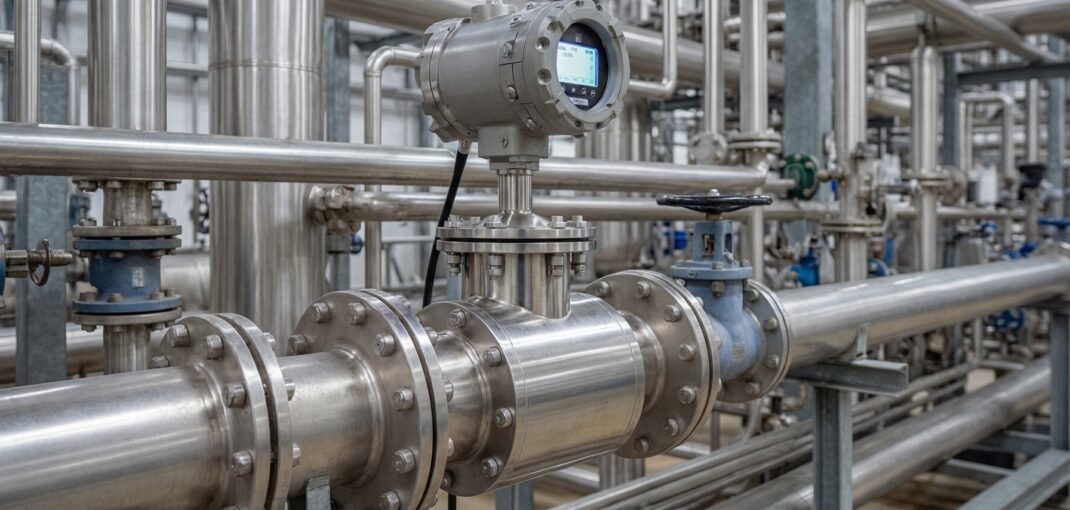
Introduction: Coriolis Flow Measurement Principle in Process Industries
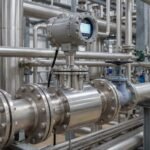
Coriolis mass flow meters have become indispensable tools in process industries, offering direct mass flow measurement, high accuracy, and multi-variable outputs. These devices operate on the Coriolis effect, where fluid flowing through oscillating tubes causes a phase shift proportional to the mass flow rate. This principle ensures reliable and precise measurements, making Coriolis meters ideal for applications in chemical processing, oil and gas, and food and beverage industries. In this article, we will focus on the commissioning of the Coriolis Mass Flow Meter Endress+Hauser Promass 100, covering zero point calibration, density measurement, and multi-variable output configuration. We will also compare it with other models like the Endress+Hauser Promass 300 N80DA618000 and the KROHNE OPTIMASS 7400 to aid in selection for chemical processing applications.
Promass 100 Installation and Mechanical Commissioning
Sensor Mounting Orientation and Vibration Isolation
Proper installation is crucial for the optimal performance of the Promass 100. The sensor should be mounted in a location that minimizes vibrations and ensures the correct orientation. The recommended mounting orientation is vertical with the flow direction upwards, which helps in the self-draining of the process fluid and reduces the risk of air pockets.
Vibration isolation is essential to prevent false readings and potential damage to the sensor. The Promass 100 is equipped with internal vibration dampening, but additional external isolation may be necessary in environments with high vibration levels. Ensure that the mounting location is free from excessive vibrations and that the sensor is securely fastened to the process line.
Piping Stress and Support Requirements
Piping stress can adversely affect the accuracy of the flow measurements. The Promass 100 should be installed in a manner that minimizes piping stress. The following guidelines should be observed:
- Use flexible couplings or bellows to isolate the sensor from piping stress.
- Ensure that the inlet and outlet piping are well-supported and aligned with the sensor.
- Avoid installing the sensor at the end of a long, unsupported pipe run.
- Use pipe hangers and supports to maintain the alignment and reduce stress on the sensor.
For detailed installation instructions, refer to the Promass 100 product manual.
Zero Point Calibration Procedure
When to Perform Zero Adjustment
Zero point calibration is a critical step in ensuring the accuracy of the Coriolis mass flow meter. It should be performed under the following conditions:
- After initial installation and before the first operation.
- Whenever the sensor is moved or subjected to mechanical stress.
- If the process conditions change significantly.
- As part of a regular maintenance schedule.
The zero point calibration ensures that the meter reads zero when there is no flow, which is essential for accurate measurements.
Step-by-Step Calibration with Promass 100
- Preparation:
- Ensure that the process fluid is not flowing through the meter.
- Isolate the meter from the process using block valves.
- Allow the meter to reach a stable temperature.
- Accessing the Calibration Menu:
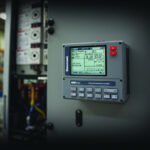
- Connect a HART communicator or use the display on the Promass 100 to access the calibration menu.
- Navigate to the zero calibration function.
- Performing the Zero Calibration:
- Initiate the zero calibration process.
- The meter will automatically detect the zero point and adjust the reading accordingly.
- Wait for the confirmation message indicating that the calibration is complete.
- Verification:
- Open the block valves and allow a small amount of fluid to flow through the meter.
- Verify that the meter reads zero when there is no flow.
Zero Stability Verification
After the zero point calibration, it is important to verify the zero stability. This can be done by monitoring the meter readings over a period of time to ensure that there is no drift. The Promass 100 is designed for high zero stability, but environmental factors and process conditions can affect the zero point. Regular verification ensures consistent performance.
Density Measurement and Multi-Variable Output
Configuring Density Channel for Concentration Monitoring
The Promass 100 offers density measurement capabilities, which are particularly useful in chemical processing for concentration monitoring. To configure the density channel:
- Access the Density Configuration Menu:
- Use the display or a HART communicator to access the density configuration menu.
- Set the Reference Density:
- Enter the reference density of the process fluid.
- This value is used to calculate the concentration.
- Enable Concentration Monitoring:
- Activate the concentration monitoring function.
- Set the desired concentration units (e.g., %, g/L).
- Calibrate the Density Measurement:
- Perform a density calibration using a known standard.
- This ensures the accuracy of the density and concentration readings.
4-20mA and HART Output Assignment
The Promass 100 supports both 4-20mA and HART outputs, allowing for flexible integration with control systems. To configure the outputs:
- Access the Output Configuration Menu:
- Use the display or a HART communicator to access the output configuration menu.
- Assign Variables to the 4-20mA Output:
- Select the variable (e.g., mass flow, density, temperature) to be transmitted via the 4-20mA output.
- Set the scaling and range for the output.
- Configure HART Parameters:
- Set the HART device address and other communication parameters.
- Assign additional variables to be transmitted via HART.
- Save and Exit:
- Save the configuration settings and exit the menu.
For more detailed instructions, refer to the Promass 100 product manual.
Promass 300 vs Promass 100: Feature Comparison
The Promass 300 offers several advanced features compared to the Promass 100. Here is a comparison of the two models:
| Feature | Promass 100 | Promass 300 |
|---|---|---|
| Accuracy | 0.1% of rate | 0.05% of rate |
| Turndown Ratio | 1:10 | 1:30 |
| Materials of Construction | Stainless Steel, Hastelloy | Stainless Steel, Hastelloy, Titanium |
| Communication Protocols | HART, PROFIBUS PA, FOUNDATION Fieldbus | HART, PROFIBUS PA, FOUNDATION Fieldbus, Modbus, EtherNet/IP |
| Diagnostics | Basic | Advanced |
| Display | LCD | Color LCD |
| Power Supply | 24 VDC | 24 VDC, 12 VDC |
The Promass 300 provides higher accuracy and a wider turndown ratio, making it suitable for more demanding applications. It also offers a broader range of communication protocols and advanced diagnostics, which can be beneficial for complex process control systems.
Comparison Table: Coriolis Meter Models for Chemical Application
| Model | Maximum Flow Rate | Pressure Rating | Temperature Range | Communication Protocols |
|---|---|---|---|---|
| Promass 100 | 100 kg/min | 100 bar | -50 to 200°C | HART, PROFIBUS PA, FOUNDATION Fieldbus |
| Promass 300 | 100 kg/min | 100 bar | -50 to 200°C | HART, PROFIBUS PA, FOUNDATION Fieldbus, Modbus, EtherNet/IP |
| KROHNE OPTIMASS 7400 | 600 kg/min | 150 bar | -40 to 180°C | HART, PROFIBUS PA, Modbus, EtherNet/IP |
| Emerson 8711ATA30FRE | 600 kg/min | 40 bar | -20 to 150°C | HART, Modbus, EtherNet/IP |
This table provides a quick reference for comparing different Coriolis meter models based on key specifications. The choice of model will depend on the specific requirements of the application, such as flow rate, pressure, and temperature range.
FAQ
1. What is the typical accuracy of a Coriolis mass flow meter?
The typical accuracy of a Coriolis mass flow meter is around 0.1% of the measured rate, but some models like the Promass 300 offer even higher accuracy of 0.05%.
2. Can Coriolis meters measure density and concentration?
Yes, Coriolis meters can measure density and concentration. The density measurement capability allows for the calculation of concentration when the reference density of the process fluid is known.
3. How often should zero point calibration be performed?
Zero point calibration should be performed after initial installation, whenever the sensor is moved, if process conditions change significantly, and as part of a regular maintenance schedule.
4. What communication protocols are supported by the Promass 100?
The Promass 100 supports HART, PROFIBUS PA, and FOUNDATION Fieldbus communication protocols.
5. What is the maximum flow rate for the Promass 100?
The maximum flow rate for the Promass 100 is 100 kg/min.
Conclusion and CTA
Commissioning a Coriolis mass flow meter involves several critical steps, from installation and mechanical commissioning to zero point calibration and output configuration. The Coriolis Mass Flow Meter Endress+Hauser Promass 100 offers a reliable solution for accurate mass flow and density measurement in chemical processing applications. For those seeking advanced features, the Promass 300 provides higher accuracy and additional communication protocols. Proper commissioning and calibration are essential for optimal performance and longevity of the meter.
If you are looking to purchase a Coriolis mass flow meter, consider the specific needs of your application and the features offered by different models. For more information or to make a purchase, visit our website or contact our sales team.